
Distributed energy resources (DERs) are often treated like second-class grid citizens, perceived as a problem to be mitigated. It’s time to rethink this. The flexibility embedded in DERs is extremely valuable and as of yet, it’s mostly an untapped resource. It’s not just valuable on the local distribution grid: it’s an untapped asset for the bulk power system also.

DER flexibility unlocks latent value within the Grid
From Marginal to Core: A Global Consensus Emerges
New international studies, from Switzerland to Midcontinental U.S., have converged on the same, potentially surprising, finding: the lowest-cost path to firm renewable power (i.e. reliable 24/365 renewable power) includes overbuilding solar PV and deliberately curtailing excess generation. To compare against status quo energy providers and prices, a case study from the State of Minnesota showed that firm PV generation could be achieved at a production cost equal to or below current conventional generation.
This overbuilding with a curtailment approach, often referred to as an implicit storage strategy, reduces reliance on expensive batteries and firming fossil backup. It’s cheaper, faster, and scalable. And yet, current policy and market rules do not encourage it; often, they are outright punishing it.
Ratepayers Win. So Why Isn’t this the Norm?
As a starting point on this discussion, it’s worth noting that the common trend of building solar with a high DC to AC ratios can be considered a form of baked in curtailment (i.e. the array will never produce more than the AC rating of the system, even if the DC parts of the array, on some days, may be capable of producing much more), so this overbuilding is kind of not new. Outside of this limited example, though, curtailment (and specifically dynamic curtailment) is not a common solution during interconnection and hosting capacity discussions. There are a number of factors here, but the predominant unsolved issue is that DER owners are expected to bear the burden of curtailment without compensation. This situation often spirals downward into a complex and often fruitless attempt to discover and define the magnitude of any such future curtailment. The exercise on the surface seems valuable because in theory, it would enable developers and financiers to safely commit capital to these new projects (assuming they were given permission to go ahead with dynamic curtailment as an expected reality). The problem is, no one has a crystal ball and hence, no one is willing to precisely define and legally enforce future curtailment expectations. Ultimately, it is flexibility that is required here and largely speaking, this is where things are stuck.
The Solution: Paying for Grid Services Provided by DER
Curtailment is a grid service. It is very similar to Demand Response, in that devices at the grid edge are paid / compensated to adjust their behavior for the benefit of the wider grid.
Treating curtailment as a first class grid service is what’s needed. Compensating DERs for curtailed energy would unlock the following benefits:
- Grid resilience: More distributed capacity at the edge relieves stress on distribution and transmission systems.
- Lower system costs: Overbuilt DERs are cheaper than massive storage, distribution, or transmission system upgrades.
- Faster deployment: Developers are eager to build—but they require a predictable revenue model.
What Good Policy Looks Like
Here’s what a forward-looking regulatory framework might include:
- Guaranteed Interconnection with Dynamic Curtailment controls: Let DERs connect freely when using the prescribed advanced inverter controls that allow system operators to treat DER as a useful grid service they can control (see Zero IX).
- Measured Curtailment with Transparent Metrics: Track curtailment down to the kWh.
- Fair Compensation for Lost Output: Pay DERs for curtailed energy using pre-agreed rates. Grid planning processes define these targeted region or feeder specific curtailment compensation rules (this provides long term clarity for DER developers and the rates will be specifically structured to maximize societal benefits)
- Financially optimized Grid Upgrades: Let utilities decide when to upgrade infrastructure—but policy and rate basing rules should incentivise utilities to do this when it becomes financially (and operationally) the better option compared to ongoing curtailment payouts.
- Open APIs & Interoperability: Make participation in flexibility services seamless and standardized.
From Policy Idea to Implementation
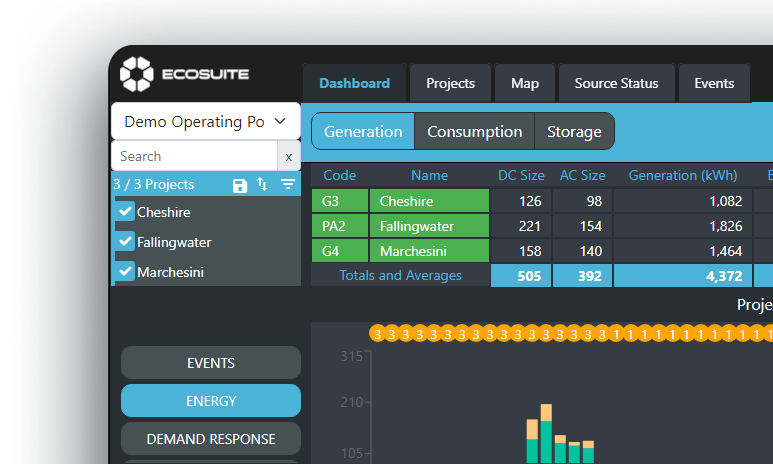
Dynamic Hosting Capacity enabled via curtailment controls isn’t just a concept anymore: it’s a deployable practice. Technologies like autonomous Volt/VAr support and interactive load shifting are already field-proven. Leveraging open technologies like OpenADR and 1547-2018, which can and are built into the backbone of products like Ecosuite, to help utilities and developers deploy at scale. The opportunity to extract more value from the current grid is real.
Closing Thought
A solar kWh that’s curtailed isn’t wasted—it’s working silently to reduce system-wide costs. It’s time policy acknowledged that value. This article has made clear why paying for curtailment is essential to unlock this opportunity.
Let’s stop leaving distribution flexibility on the table. Let DERs do more.
→ info@ecosuite.io


 Unlimited external users



Pingback: Zero IX: Revolutionizing Renewable Energy Interconnection - Ecosuite
Pingback: Dynamic Hosting Capacity–a stellar opportunity to accelerate distributed energy - Ecosuite