Do you own your data, do you hold the keys to your grid edge tech stack?
Data Ownership:

While most are aware that there are data silos everywhere, they view them as mere inconveniences or inefficiencies to work around. But it’s often worse than this: many data silos have default legal positions that mean data ownership is at best unclear. The true nature of legal ownership is often not discovered until requests for direct access are made, which is when the nightmare begins…
For example, it is common to outsource EPC and then O&M to third party companies. Upon closer inspection, you may find your legal relationship with the DAS platforms chosen by these third parties, and the associated data streaming off of your DER projects, are sub-optimal, at best. You may find that somehow you are no longer the full owner of “your” data. i.e. you have lost full legal control of your data, and likely to someone elses advantage.
The fix for this situation is to be explicit with data ownership from the beginning. Like we do here at Ecosuite, we allow organization owners (org owners) to choose explicitly the nature of data access that any third parties might be allowed, with respect to their own data (Ecosuite is a mere custodian of the org owner’s data and the org owner is in control of who else might have access to this data and under what terms). Some examples of options currently available are shown below. These options quickly give an understanding of the fine grained control that an org owner has over their data:

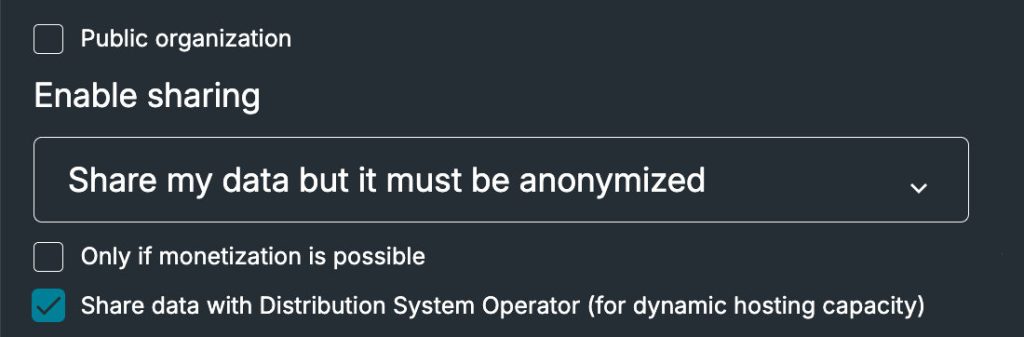
You may also note that if you wish to monetize your data, Ecosuite is able to facilitate that for you. We do this by making the high level info about your datasets visible to data scientists and the like, hence amplifying the likelihood of data monetization occurring. In short, Ecosuite becomes your partner in the sometimes complex process of data monetization.
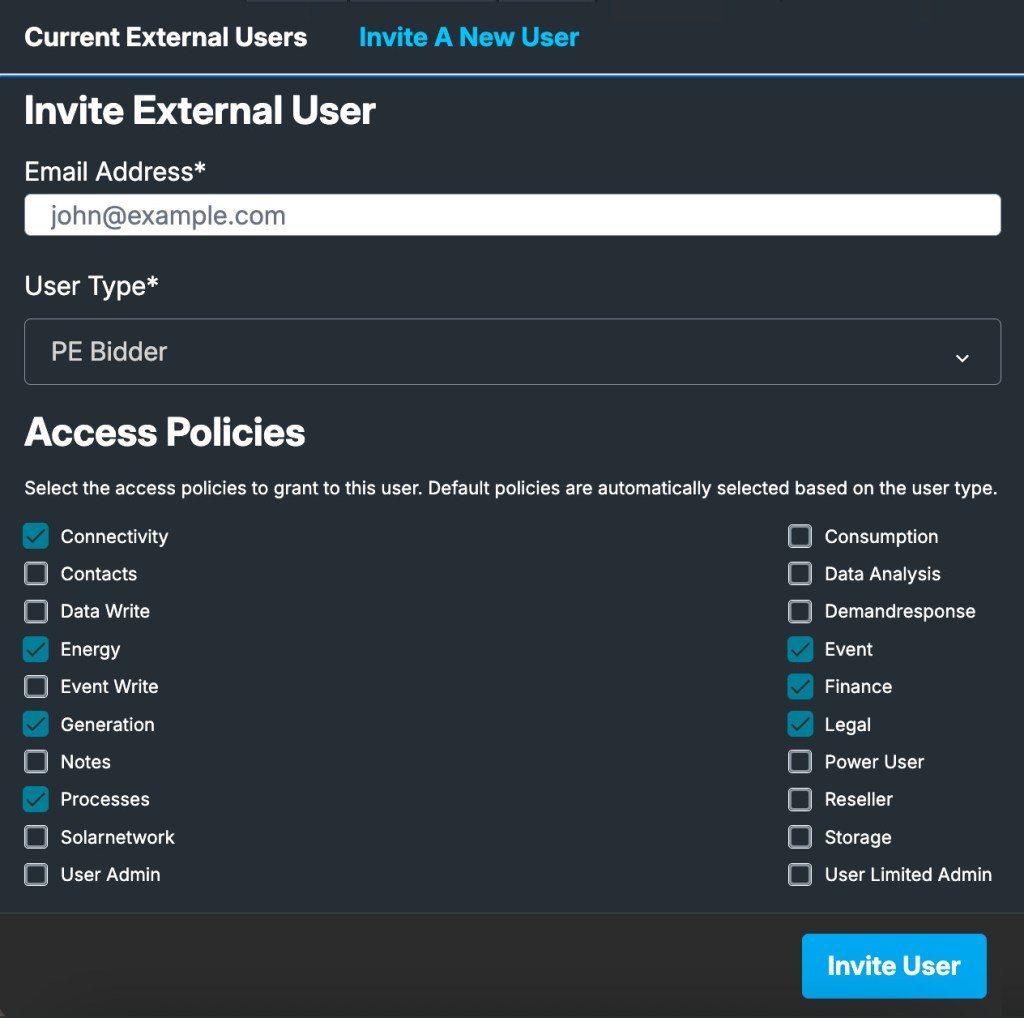
This approach of giving org owners control, goes beyond data and extends to functional access as well. We allow our org admins to choose who they might invite as external collaborators into their world, which is empowering for not only org owners, but also for any external parties (this is another avenue for eliminating waste and maximising results within the broader business ecosystem):
WIth this situation locked down and under control, let’s now turn our attention to the ongoing task of supporting, maintaining and refining physical equipment configuration at the grid edge. In the next section, learn about your right (or lack thereof) to improve and repair devices at the grid edge.
If you would like a deeper dive into understanding the underpinnings of Ecosuite’s ability to offer this sort of societal benefit focused thinking, please check out SolarNetwork, the SolarNetwork Foundation and this Ava Lovelace Institute article. All are directly relevant.
Right to Repair:

What happens when a manufacturer or service provider goes out of business? Initially, no big deal, right? There are plenty of other providers. Eventually however, something in your grid edge tech stack from this company will stop working, require maintenance or reconfiguration for other reasons. What happens now? You might have no one to turn to, so is your only remaining option is to rip it out and start again?
How and why does this happen? Is there any elegant way to fix this issue and, more importantly, as an industry, how do we prevent this situation from occurring in the first place?
An obvious solution is to ensure that you, as the customer and owner of all this grid edge tech, receive the metaphorical “keys” to the tech. You must receive all the credentials necessary to access the devices at the lowest level and you must also be provided with access to all of the documentation and knowledge required to make effective use of this access. This does not necessarily mean that you need to know how to leverage this knowledge, but if the worst happens, you need to have access to this knowledge and the associated capabilities. Ultimately, it means knowing you have the option to learn and leverage this knowledge if required, or allowing your selected service provider to leverage it and deliver outcomes on your behalf.
Here at Ecosuite, this is our default position. All our Edge Compute Node (ECN) solutions provide an explicit legal right to the edge compute deployed software, the associated configuration data and, of course, the necessary security tokens and credentials. To date, all of our ECN solutions are 100% open source and we intend to keep it that way (if proprietary components are ever chosen or desired to be leveraged for whatever reason – this will be clearly identified). In parallel with this, admin level access to the necessary credentials and associated software repositories are explicitly available to the customer (via their own controlled org admin access). This is all part of our standard project onboarding.

Championing open-source and empowering customers
In conclusion, ensuring clarity around data ownership and upholding the “Right to Repair” are paramount for organizations operating at the grid edge. The risks of ambiguous data ownership, particularly when outsourcing, can lead to a loss of control over valuable data and financial exploitation by third parties. Similarly, a lack of access to device credentials and documentation can leave organizations vulnerable when manufacturers or service providers become unavailable, necessitating costly replacements, rather than simple repairs or reconfigurations. Ecosuite directly addresses these concerns by explicitly granting and providing customers with control over their data, acting in that role as custodian, and by providing full legal rights and access to their edge compute software, configuration data, and security tokens. By championing open-source solutions and empowering customers with the necessary keys to their technology, Ecosuite ensures that organizations maintain true ownership and control over their grid edge infrastructure.
With Ecosuite you will never be left out in the cold!
→ info@ecosuite.io


 Unlimited external users